
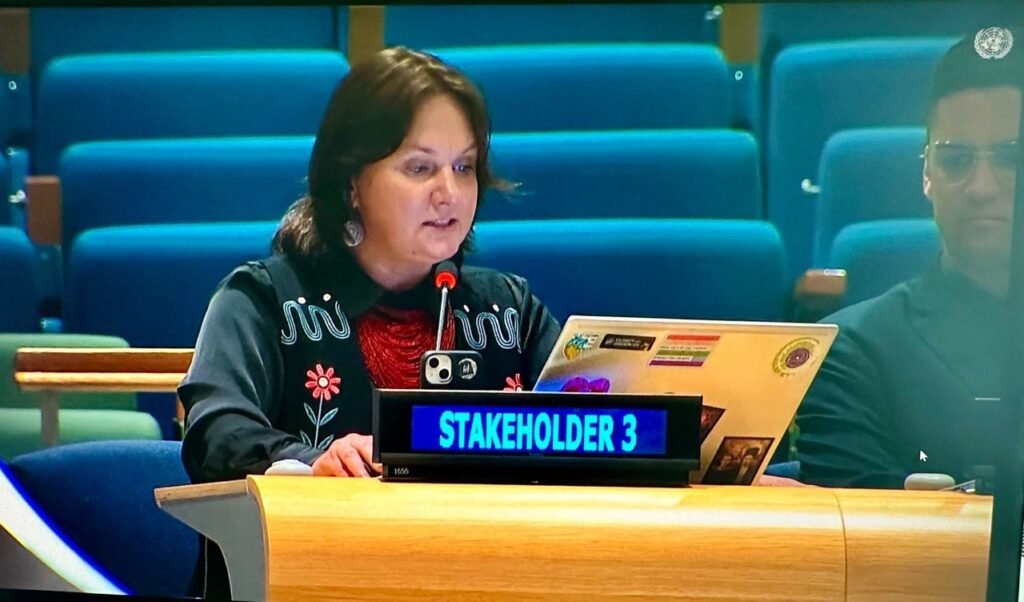
“We cannot end AIDS while criminalising the people most affected by it and the organisations that support them” – said Ganna Dovbakh, EHRA Executive Director and Rise & Decriminalize Movement activist, at the Thematic Panel 3 “Community Leadership – Driving an Inclusive and Sustainable HIV Response” on 23rd June within the 2026 United Nations General Assembly High-Level Meeting on HIV/AIDS.
The 2026 United Nations General Assembly High-Level Meeting on HIV/AIDS (HLM) – an essential accountability mechanism for the global HIV response – is taking place now on 22–23 June 2026, in New York.
Ganna Dovbakh, EHRA Executive Director and Rise & Decriminalize Movement activist, spoke on behalf of communities from Eastern Europe and Central Asia in 2 thematic sessions:
- On 22nd June at the Thematic Panel 2: “Equitable Access to Science, Technology and Innovation – Accelerating HIV Prevention, Testing, Treatment and Care”. Here what was highlighted in the regional perspective:
In EECA region we are discussing a lot how science, technology and innovation can make health services truly accessible for key populations — people who use drugs, sex workers, LGBT+ people, women living with HIV, adolescents and young people, migrants, and people in prison. At the same time, there are evidence-based community interventions that have not been innovations for 30 years in some countries, yet are still treated as pilot projects in others. Community-led prevention and harm reduction are well-known and proven approaches; we simply need to scale them up and ensure their sustainable support.
Some of these innovations are truly transformative. Long-acting buprenorphine as opioid agonist treatment means that one injection per month can allow a person living with opioid dependence to lead a productive life — to work, study, and live without having to visit a clinic every day.
Opioid agonist treatment and naloxone remains one of the most effective ways to prevent HIV transmission and reduce overdose deaths, but both remains still inaccessible to the majority of people who use drugs in the EECA region because of persistent misconceptions and a lack of trust in scientific evidence.
PrEP is indeed an important innovation. But harm reduction and outreach services must be in place to help marginalized communities trust health services and remain committed to PrEP or ART.
For people who use stimulants and new psychoactive substances, there are also innovative approaches such as drug checking services and counselling in nightlife settings. Evidence shows that after consultations with peers, people tend to use substances less frequently and engage in fewer risky behaviours.
Harm reduction combined with social counselling and integrated mental health support may no longer be considered innovative, but community-led organisations are now delivering these services through digital platforms, online counselling tools, and even by sending essential materials by post.
Support to survivors of gender based violence is not innovative, but it is still not accessible for women living with HIV, sex workers or women using drugs.
Rapid testing is not an innovation in itself, yet community organisations still have to advocate and overcome barriers to introduce and sustain community-based testing.
Community-led prevention for key population is not just a test, clean needle or referrals to doctor. It is legal aid for people affected by criminalising laws, mental health support, pathways to housing, and connections to social care. Comprehensive, community-based, peer-led prevention — delivered by people with lived experience — remains one of the most cost-effective evidence based public health interventions we have.
- On 23rd June at the Thematic Panel 3 “Community Leadership – Driving an Inclusive and Sustainable HIV Response”. Full intervention text below.
I am representing 200 organisations united in Eurasian Harm Reduction Association and more broadly – а joint Rise and Decriminalize Movement. I speak on behalf of communities from Eastern Europe and Central Asia, the only region where the HIV epidemic is still growing.
Our region is unfortunately known for the lack of governmentally funded access to evidence-based responses among criminalised and stigmatized communities, such as harm reduction, in the largest countries of the region.
The region is also facing a war comparable in scale to World War II, causing death, loss of health and homes, human rights violations, and displacement of millions of ukrainians.
Across our region, people are criminalised or put in prison for drug use, sex work, sexual orientation, gender identity, HIV transmission or just living with HIV, or illegal migration. These laws drive people away from HIV prevention, testing, treatment, harm reduction, and care. Women who use drugs or live with HIV often have no access to protection, care, or shelter when facing gender-based violence.
The same region is experiencing unprecedented shrinking civic space and attacks on community-led organisations. We are facing the expansion of so-called anti-drug propaganda laws, anti-homo propaganda laws, foreign agent laws, and “undesirable organisation” designations. These measures are dismantling organisations that provide lifesaving services, monitor programmes, and hold governments accountable.
In this region community are leading HIV response on the local and national level filling gaps and connecting medical interventions to people.
I have the honor of speaking on behalf of strong, capable, and united communities of people who use drugs, sex workers, LGBTIQ+ people, women living with HIV, adolescents and young people, migrants, and people in prison.
Our central message is simple: we cannot end AIDS while criminalising the people most affected by it and the organisations that support them. We need explicit protection of civil society space in EECA and a commitment to repealing laws that label communities as threats.
Community leadership is not optional. Community-led services, monitoring, and advocacy must be recognised as integral components of national health systems, and community-led organisations must receive sustainable funding. Key populations and affected communities must be meaningfully involved in decision-making at every level.
You cannot end AIDS while silencing communities. Ending AIDS by 2030 requires decriminalisation, protection of human rights, defence of civic space, and investment in the communities already leading the response.