“The role of the UNAIDS Joint Programme and its co-sponsors was crucial in coordinating efforts to ensure access to essential health services for people living with and affected by HIV” – Ganna Dovbakh, EHRA Executive Director and Rise & Decriminalize Movement activist.
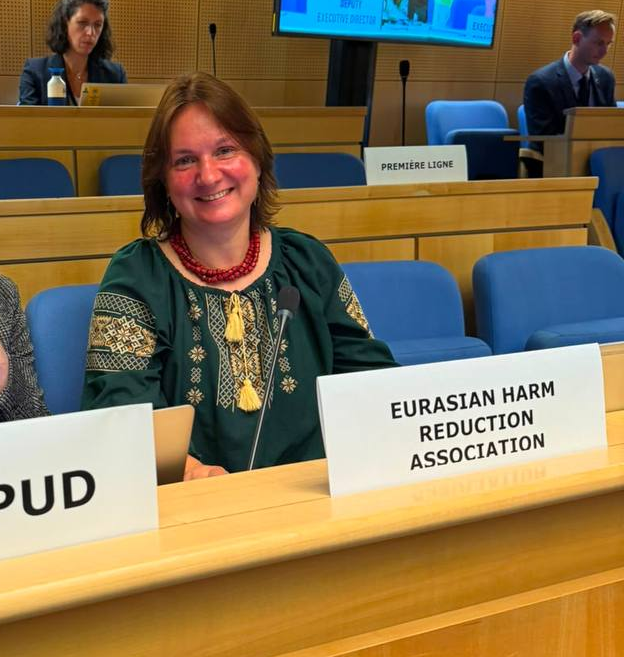
The Joint United Nations Programme on HIV/AIDS (UNAIDS) is guided by a Programme Coordinating Board (PCB), which acts as the governing body on all programmatic issues concerning policy, strategy, finance, monitoring, and evaluation of UNAIDS.
The 58th PCB meeting was held from 30 June to 2 July 2026 in Geneva, Switzerland.
On 1 July 2026 the following statement was delivered by Ganna Dovbakh, EHRA Executive Director and Rise & Decriminalize Movement activist delivered the following statement at the meeting:
From the perspective of the Eurasian key criminalised communities united in the Rise & Decriminalize Movement, as well as our Ukrainian members, I would like to highlight the important role of UNAIDS country offices and the regional team in responding to the crisis caused by Russia’s war against Ukraine, the resulting humanitarian emergency, and the waves of forced refugees arriving in neighbouring countries.
Through productive cooperation between the UNAIDS regional team, the co-sponsors, and regional and national key population networks, we achieved the possibility of ensuring the continuity of essential HIV services, including HIV prevention, HIV treatment, PrEP, harm reduction, opioid agonist therapy, sexual and reproductive health and rights services, support for victims of gender-based violence, and, importantly, the integration of these services with mental health support. We are deeply grateful to our partners in the European Union—including Poland, Czechia, Germany, the Netherlands, and Lithuania—as well as Canada and all the countries that opened their hearts, made their health systems accessible, and ensured that Ukrainian people in need could receive lifesaving medicines and healthcare.
The introduction of innovations such as long-acting antiretroviral therapy (ART) and Buvidal, a long-acting opioid agonist treatment, also played an important role in expanding and securing health service options for key populations during the crisis.
The role of the UNAIDS Joint Programme and its co-sponsors at both national and regional levels was crucial in coordinating efforts to ensure access to essential health services for people living with and affected by HIV. This coordination brought together national health and social care stakeholders, humanitarian organisations, community-based organisations, and international donors to deliver an effective response under extremely challenging circumstances.
The promotion of evidence-based approaches to the HIV response among key populations—including people who use drugs, sex workers, LGBTIQ+ people, and people in prisons—by UNAIDS is especially important in the Eastern Europe and Central Asia (EECA) region, which remains the only region in the world where the HIV epidemic continues to grow and AIDS-related deaths are increasing. This is largely due to the lack of understanding, political commitment, and national support for effective, evidence-based approaches in several countries across the region.
Globally, it is also crucial to keep the EECA region high on the international HIV agenda, particularly regarding the response for key populations. This is especially important for the UN system at a time when civil society and community-based organisations serving key criminalised communities are facing an alarming and rapidly shrinking civic space. When organisations like our members are labelled “foreign agents” simply because they seek resources to continue providing harm reduction or HIV prevention services for gay or transgender people, this is unjust. When organisations are declared “undesirable” and individuals can face criminal punishment simply for maintaining contact with these partners, it creates a dangerous environment that undermines the development of effective health and social responses to HIV.
Combined with the current global funding crisis and the rise of anti-human rights and anti-gender equality political narratives, these developments are severely limiting the ability of civil society to participate in national HIV decision-making processes. In this context, the role of UNAIDS and its co-sponsors is to continue and strengthen their support for community organisations by ensuring their meaningful engagement in the planning, implementation, and monitoring of HIV response programmes.
In the EECA region, we need a strong UNAIDS Joint Programme with an ambitious vision, a clear position, and adequate resources to support key populations and uphold a rights-based, evidence-informed HIV response.