The Joint United Nations Programme on HIV/AIDS (UNAIDS) is guided by a Programme Coordinating Board (PCB), which acts as the governing body on all programmatic issues concerning policy, strategy, finance, monitoring, and evaluation of UNAIDS.
The 58th PCB meeting was held from 30 June to 2 July 2026 in Geneva, Switzerland.
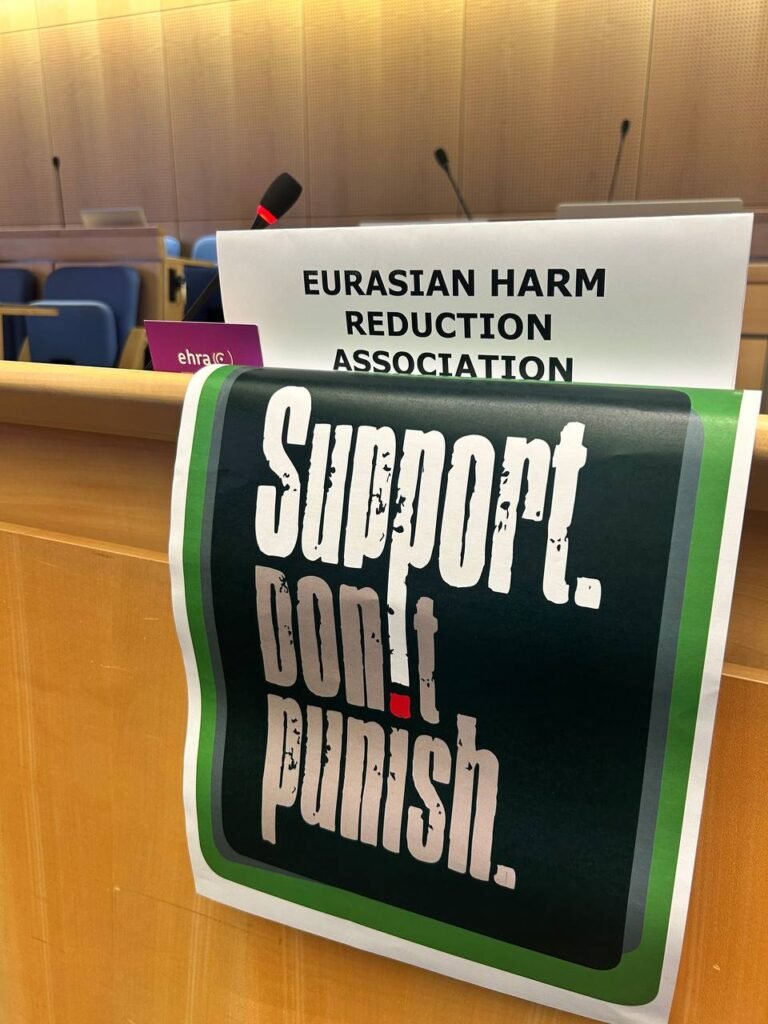
On 2 July during the Thematic Segment on harm reduction, Ganna Dovbakh, EHRA Executive Director and Rise & Decriminalize Movement activist delivered the following statement:
What works in harm reduction services integration to public health systems in CEECA
I am from Ukraine, a post-Soviet country, and I remember repressive psychiatry and compulsory narcological services that functioned more like forced labour camps of the Gulag than healthcare.
Over the past 30 years, civil society, communities, and professionals have transformed these systems into evidence-based services responding to the real needs of people who use drugs. Unfortunately, not all policymakers have made this journey from totalitarian thinking. Some still claim that prisons and prohibition are the right response to drug use.
Today, most health systems in EECA region recognize harm reduction and increasingly integrate it into national health systems and budgets. Governments are still generally more willing to fund medical components of harm reduction such as opioid agonist treatment or HIV, Hepatitis or TB testing or PreP. This is already happening across the CEECA region—from Bosnia and Herzegovina to Georgia, Moldova, Lithuania, and Kazakhstan. As we have heard from Ukraine, expanding access to a wider range of medications within OAT is entirely realistic.
Integration of OAT and broader harm reduction with mental health is already progressing in a lot of countries of the region – needed we all affected by war trauma and uncertainty.
There is also growing recognition that without outreach workers, community navigators, patient advocates, and peer supporters, many people who use drugs never reach HIV, TB, hepatitis, sexual and reproductive health, or other services because of decades of stigma, discrimination, and criminalization. Sometimes even local police and drug control professionals acknowledge this—we all need harm reduction to make our communities safer.
Making community-led harm reduction sustainable is actually not complicated. We already have successful models.
In Poland, MONAR has provided publicly funded harm reduction services in Kraków since 1996. Finland requires every municipality to provide harm reduction services. Germany, Switzerland, Estonia, Czechia, Lithuania, North Macedonia, Ukraine, and others demonstrate that sustainable public investment is possible. Across Eastern Europe and Central Asia, Global Fund to fight HIV, TB and Malaria transition processes have also helped establish social contracting mechanisms allowing governments to finance civil society organizations.
Community-led harm reduction has proven its effectiveness in HIV prevention, testing, PrEP, linkage to care, overdose prevention, and access to healthcare and justice. Sustainable financing can be organized through transparent three- to five-year contracting based on quality and outcomes. Governments simply need to trust the expertise of civil society and allow flexibility to respond to changing drug markets and community needs—whether overdose prevention, drug checking, fentanyl test strips, safer consumption services, or support for survivors of gender-based violence.
Some countries have tried another model by hiring people with lived experience into medical institutions or multidisciplinary teams. Moldova, for example, integrated community paralegals into the governmental legal aid programme.
Our regional experience shows that when community representatives are absorbed into public institutions as individuals, something essential is lost. Without community organizations, peer networks, community-led monitoring, and collective advocacy, lived experience alone cannot replace the power of an organized community.
Imagine one peer worker. They conduct outreach, respond to overdoses at night—sometimes as the only person carrying naloxone—support people after arrest, accompany them to healthcare, make sure OST continues in hospital, provide counselling, help women escaping gender-based violence, document barriers to treatment, conduct community-led assessments, and advocate for better policies and harm reduction supplies.
At the same time, this person often has only a temporary contract because they lack formal qualifications required by the public system, no health insurance, no paid leave, limited labour protections, and earns around 100 US dollars per month—sometimes only for half the year because the procurement process took too long.
This is neither sustainable nor fair. It is like asking someone to sit on a chair with only one leg.
Without strong community organizations and collective action addressing criminalization, even the most committed peer worker cannot simultaneously provide services, strengthen communities, conduct monitoring, and advocate for policy change.
The sustainable solution is to fund community-led organizations directly through public budgets.
Across the CEECA region, community-led organizations have developed tailored services for young people through drug checking and nightlife harm reduction, for women through gender-sensitive and gender-transformative services, provide peer legal and psychological support, referrals, community-led monitoring, and human rights protection. Together, they represent thousands of trained community members who are already an essential part of our health systems.
At the same time, maintaining strong community organizations in the EECA region—and globally—still requires dedicated support. Funding mechanisms such as the catalytic funding from Global Fund, support from Robert Carr Network Fund and the Elton John AIDS Foundation remain essential for sustaining regional and global community networks, community-led monitoring, advocacy, and core organizational costs (for us being here with you in the working day, for example).
Without sustained investment in community organizations, there can be no sustainable harm reduction. Community systems are not an addition to public health—they are part of public health.
Challenges in sustaining effective harm reduction
People do not always see the connection between foreign agent laws and the sustainability of harm reduction services, but these laws can directly threaten the existence of community-led harm reduction organizations.
With very few exceptions, governments do not fund advocacy activities through public budgets. As a result, organizations working on community-led monitoring, human rights, policy reform, or budget advocacy often have no alternative but to seek support from international donors. In many cases, these are the same organizations that provide the highest-quality harm reduction services, because service delivery, community organizing, and advocacy are closely interconnected.
Once such organizations receive foreign funding for advocacy-related work, they may be designated as “foreign agents” under restrictive legislation which is actively introduced now in several CEECA countries. In practice, this designation often results in exclusion from public funding opportunities, reputational damage, increased administrative burdens, and restrictions on their operations. Consequently, some of the most experienced and effective harm reduction providers become unable to sustain or expand their services.
We are already witnessing examples across the CEECA region where leading community-based harm reduction organizations have lost the ability to operate effectively because of foreign agent legislation.
Another concerning trend is the criminalization of so-called “drug propaganda.” Broad and vague definitions are increasingly being used to restrict the dissemination of evidence-based information on harm reduction, drug use, overdose prevention, and health services. This creates a chilling effect on public health communication and undermines efforts to reach people who use drugs with life-saving information.
Recommendations
- Ensure sustainable political commitment and public financing for community-led organizations to deliver comprehensive, diverse, and evidence-based harm reduction services tailored to the needs of different populations and communities, recognizing their essential role within health and social protection systems.
- Sustainable support for community-led organizations is critical for an effective HIV response among people who use drugs, enabling equitable access to HIV prevention, treatment, care, and support while advancing human rights and social inclusion.
- Protect and expand civic space for community-led harm reduction organizations by repealing or preventing restrictive legislation, including foreign agent laws and provisions criminalizing so-called “drug propaganda,” and by ensuring sustainable public financing for both service delivery and advocacy activities. Recognize the legitimate role of community-led organizations in monitoring, policy dialogue, human rights protection, and the design and delivery of effective HIV and harm reduction responses.