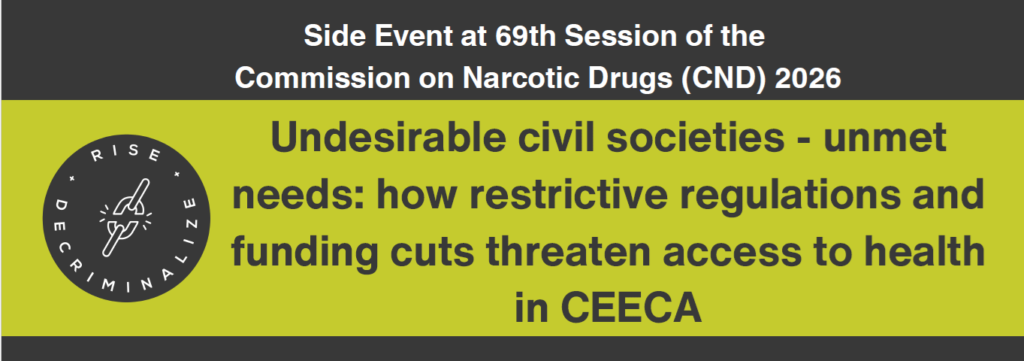
Eurasian Harm Reduction Association (EHRA) is delighted to invite you to the side event at the 69th session of the Commission of Narcotic Drugs, that will take place 9-13 March in Vienna, Austria.
The side event “Undesirable civil societies – unmet needs: how restrictive regulations and funding cuts threaten access to health in CEECA” will focus on the shrinking civic space in Central Eastern Europe and Central Asia and its effects on drug policy and community of people using drugs.
Date & time: Friday, 13th of March, 11.30-12.30 Vienna time,
Location: M6
Format: Hybrid format https://us02web.zoom.us/j/86138466835
An increasing number of countries in Central Eastern Europe and Central Asia (CEECA) region are introducing laws and practices restricting civic freedoms and narrow the space for independent civil society actions – such as “foreign agent”-type legislation, ban of so-called “LGBTQI+ propaganda” and “drug propaganda” or banning health care for all marginalised groups – for trans people, LGBTIQ+ or total prohibition of harm reduction. These measures impose additional legal, financial, and administrative pressures on organizations providing health and social care to highly criminalized and stigmatized populations, as people who use drugs in all its intersecting diversity, including LGBTQI+ communities, people living with HIV, sex workers. The situation is further aggravated by a massive cut in international and domestic funding for civil societies, driven by geopolitical instability, donor concerns about supporting organizations operating under “foreign agent” laws, and the freezing and termination of key sources of aid such as USAID.
In response to this shared crisis, four leading regional networks – EHRA, ECOM, EWNA, and SWAN started a community-driven RESILIENT project covering 10 CEECA countries as a unique initiative uniting organizations of criminalized communities for regular monitoring and evaluation of their consequences for health access and community well-being, and a coordination of advocacy response to ensure protection of human rights and lives of people.
Agenda will include:
- Comment on challenges in civil rights and liberties globally and regionally
by Zaved Mahmood, Drug Policy and Human Rights Advisor, Lead on Detention/Incarceration
Rule of Law & Democracy Section, OHCHR. - Comment on shrinking civic space and criminalization effects on HIV response
by Eamonn Murphy, Regional Director UNAIDS, Asia Pacific and Eastern Europe and Central Asia. - Comment on intersectionality implications
by Trajche Janushev, Executive director of Sex Workers Rights’ Advocacy Network (SWAN). - Analytical data based on the recently published EHRA report “Shrinking civic space and marginalised populations in Eastern Europe and Central Asia”
by Ganna Dovbakh, Executive director of Eurasian Harm Reduction Association (EHRA). - Country cases from Georgia, Hungary and Kazakhstan on the impact restrictive regulatory environments and shrinking resources have on the ability of community-led and harm reduction organizations to continue delivering health and social care services
by Marina Chokheli, Human rights and harm reduction consultant (Georgia),
Peter Sarosi, Executive Director Rights Reporter Foundation (Hungary) and
Lyubov Vorontsova, Advocacy and Community Advisor, EWNA (Kazakhstan).
Co-sponsors: